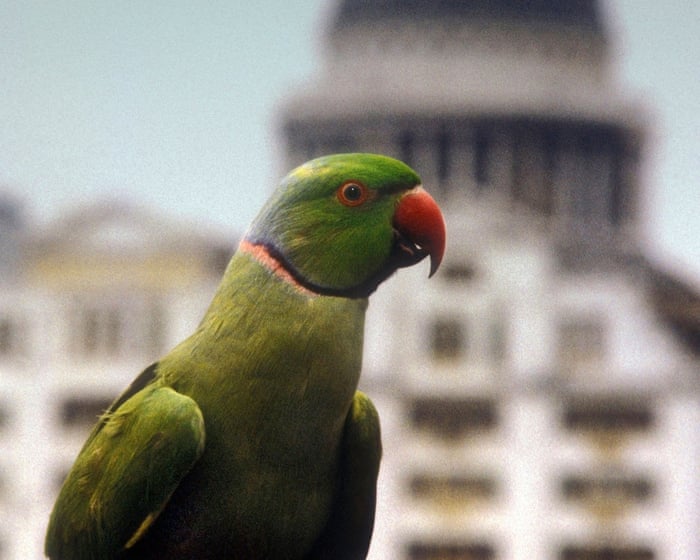
Established in UK cities for decades and much loved for their green plumage, the Himalayan birds have been recast as an ecological threat. But is the idea of invasive species itself a problem? Before we saw a single parakeet, we heard them: a disembodied static that grew louder as we approached Hither Green cemetery in south-east London. It was an early evening in late June, and we had come to witness an invasion. By the time my friend and I reached the cemetery’s western edge, the clamour was all-encompassing. We hopped the fence and picked our way through the gravestones. Above us now were the birds themselves, their kryptonite-green plumage, scab-red beaks, pearly black collars and trailing tail feathers unmistakable: Psittacula krameri, the ring-necked parakeet. Hither Green cemetery hosts one of the city’s largest roosts. Every day at dusk, a sizeable chunk of London’s feral parakeet population returns here, to a specific line of poplars. They like to spend the night in the company of their own kind. We watched them come first in ones and twos, and then in larger chirrupping squadrons. Hundreds of them, and then thousands. At maximum capacity, the trees fizzed. Here was a pandemonium, a parakeet concourse. It gave the impression of community, greeting and conversation. “This,” my friend said, “would make a great cheap first date.” Continue reading...
Alien menace or victim of xenophobia? The battle over Britain’s parakeets
The Guardian – International · By David Wingrave
Published ·
Keep reading
Related stories